

Knowledge is power get  it  Here … NallPro
      Objective:
      • IB - Primary Years Programme (PYP)

        PYP is for students aged 3 to 12. It provides schools with a curriculum framework of essential elements — the knowledge, concepts, skills, attitudes, and action that young students need to equip them for successful lives, both now and in the future. Schools work with the five elements to construct a rigorous and challenging primary curriculum for international education.

      • IB - Middle Years Programme (MYP)

        MYP emphasizes intellectual challenge. It encourages students aged 11 to 16 to make practical connections between their studies and the real world, preparing them for success in further study and in life.

    • Algebraic Factoring and Expansion
    • Radicals and Surds
    • Measurement
    • Coordinate Geometry
    • Coordinates and Lines
    • Congruence and Similarity
    • Sets and Venn Diagrams
    • Quadratic Equations
    • Quadratic Functions
    • Exponential Functions and Logarithms
    • Univariate Data Analysis
    • Trigonometry – Sine and Cosine Laws
    • Inequalities
    • Algebraic Fractions
    • Pythagorean Theorem
    • Formulae
    • Interpreting Graphs
    • Simultaneous Linear Equations
    • Transformational Geometry
    • Vectors
    • Relations Functions and Sequences
    • Properties of Exponents
    • Relations Functions and Sequences
    • Probability
    • Advanced Trigonometry
    • Financial Mathematics


      If you are IB/IBT/AP student and your marks less than 80%, not worth to study in these Programme!


    • IB - Diploma Programme (DP)

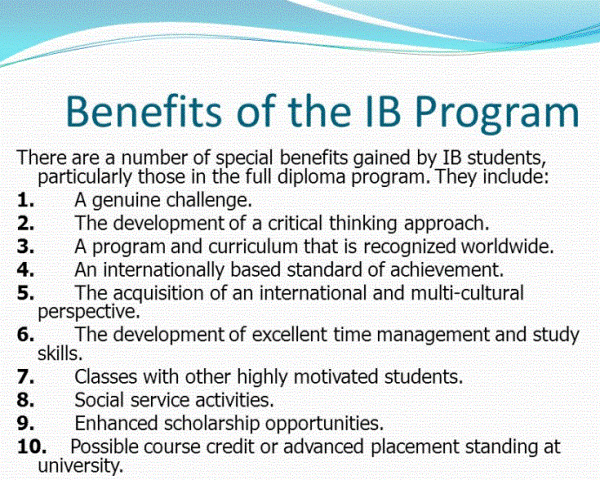
      DP is an assessed programme for students aged 16 to 19. It is respected by leading universities across the globe.

      What the DP offers students
      Through the DP, schools are able to develop students who:

      • have excellent breadth and depth of knowledge
      • flourish physically, intellectually, emotionally and ethically
      • excel in traditional academic subjects Math
      • explore the nature of knowledge through the programme’s unique theory of knowledge course.


    NallPro's Sample
    Worksheets!
    For IB &
    University Math

    Work Sheet 1

    PDF Printable version

    Work Sheet 2

    PDF Printable version

    Work Sheet 3

    PDF Printable version

    Work Sheet 4

    PDF Printable version

    IB - Diploma Programme (DP) You Will Learn...

    In Advanced Functions...(Course Breakdown)

      Functions: Characteristics and Properties
      • Functions
      • Exploring Absolute Value
      • Properties of Graphs of Functions
      • Sketching Graphs of Functions
      • Inverse Relations
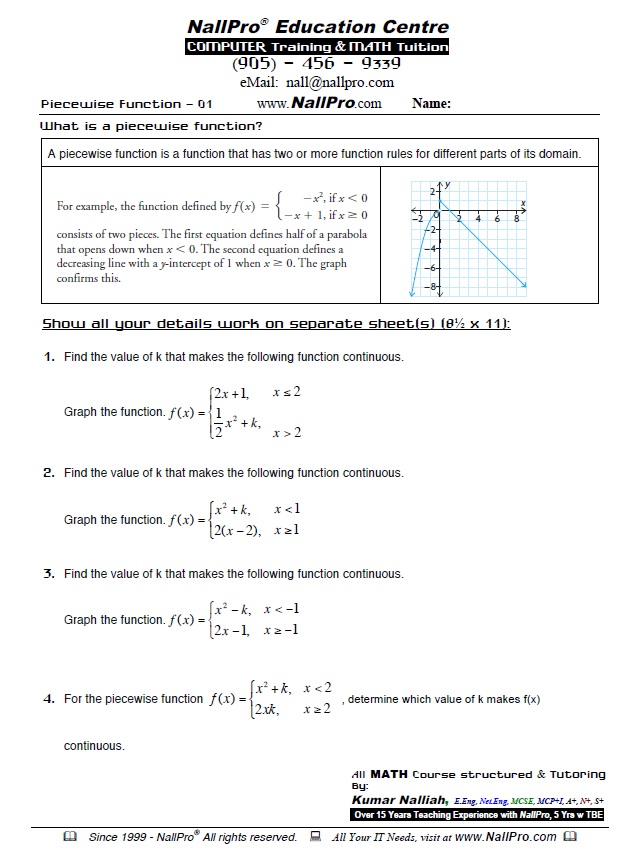
      • Piecewise Functions
      • Exploring Operations with Functions

      Functions: Understanding Rates of Change
      • Determining Average Rate of Change
      • Estimating Instantaneous Rates
      • Using Rates of Change
      • Solving Problems Involving Rates of Change

      Polynomial Functions
      • Exploring Polynomial Functions
      • Characteristics of Polynomial Functions
      • Properties of Graphs of Functions
      • Polynomial Functions in Factored Form
      • Transformations of Cubic and Quartic Functions
      • Dividing Polynomials
      • Factoring Polynomials
      • Factoring a Sum or Difference of Cubes

      Polynomial Equations and Inequalities
      • Solving Polynomial Equations
      • Solving Linear Inequalities
      • Solving Polynomial Inequalities
      • Rates of Change in Polynomial Functions

      Rational Functions, Equations, and Inequalities
      • Graphs of Reciprocal Functions
      • Exploring Quotients of Polynomial Functions
      • Graphs of Rational Functions of the Form f(x)
      • Solving Rational Equations
      • Solving Rational Inequalities
      • Rates of Change in Rational Functions

      Trigonometric Functions
      • Radian Measure
      • Radian Measure and Angles on the Cartesian Plane
      • Exploring Graphs of the Primary Trigonometric Functions
      • Transformations of Trigonometric Functions
      • Exploring Graphs of the Reciprocal Trigonometric Functions
      • Modelling with Trigonometric Functions
      • Rates of Change in Trigonometric Functions

      Trigonometric Identities and Equations
      • Exploring Equivalent Trigonometric Functions
      • Compound Angle Formulas
      • Double Angle Formulas
      • Proving Trigonometric Identities
      • Solving Linear Trigonometric Equations
      • Solving Quadratic Trigonometric Equations

      Exponential and Logarithmic Functions
      • Exploring the Logarithmic Function
      • Transformations of Logarithmic Functions
      • Evaluating Logarithms
      • Laws of Logarithms
      • Solving Logarithmic Equations
      • Solving Problems with Exponential and Logarithmic Functions
      • Rates of Change in Exponential and Logarithmic Functions


    In Data Management...(Course Breakdown)

      Tools for Data Management
      • Statistics of One/Two Variable
      • Permutations and Organized Counting
      • Combinations and the Binomial Theorem
      • Probability Distributions
      • The Normal Distribution


    In Calculus...(Course Breakdown)

      Limits
      • The Limit of a Function
      • Properties of Limits
      • Limit of continuity at a point
      • One-Side Limits
      • Limit as x Approaches to Infinity

      Differential calculus
      • First Principles
      • Rules of Power, Sum and Difference
      • Product Rule and Quotient Rule
      • Chain Rule
      • Derivative of Trigonometric Functions
      • Derivative of Exponential Functions
      • Derivative of The Natural Log Functions
      • Implicit Differentiation
      • Higher Order Derivative

      Differential Calculus and Curve Sketching
      • Tangents and Normals
      • Curve Sketching - Increasing and Decreasing Functions
      • Curve Sketching - Global Maxima and Minima
      • The Second Derivative and its Application
      • Rational Functions - Sketching the Graph

      Applications of Differential Calculus
      • Rates Of Change
      • Applied Rates of Change
      • Kinematics - Motion Along a Straight Line
      • Applied Maxima and Minima Problems

      Integration and Its Applications
      • Antidifferentiation & The Indefinite Integral
      • Determining The Indefinite Integral
      • The Definite Integral
      • Applications of Integration
      • Introduction to the Area Beneath a Curve
      • The Definite Integral and Areas
      • Applications to Kinematics

    In Vectors...(Course Breakdown)

      An Introduction to Vectors
      • Addition and Subtraction of Vectors
      • Multiplication of a Vector by a Scalar
      • Properties of Vectors
      • Vectors in R2 and R3
      • Operations with Algebraic Vectors in R2 and R3
      • Linear Combinations and Spanning Sets

      Applications of Vectors
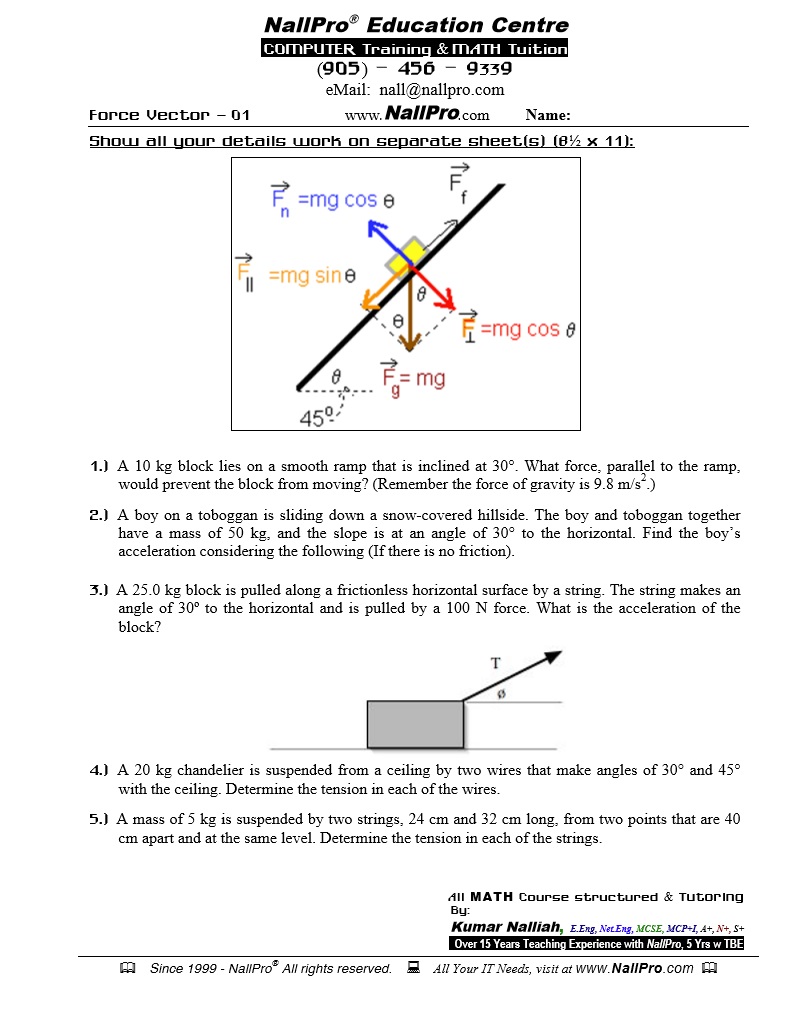
      • Vectors as Forces
      • Velocity
      • The Dot Product of Two Geometric/Algebraic Vectors
      • Scalar and Vector Projections
      • The Cross Product of Two Vectors
      • Applications of the Dot Product and Cross Product

      Equations of Lines and Planes
      • Vector and Parametric Equations of a Line in R2
      • Cartesian Equation of a Line
      • Vector, Parametric, and Symmetric Equations of a Line in R3
      • Vector and Parametric Equations of a Plane
      • The Cartesian Equation of a Plane
      • Sketching Planes in R3

    Extension Concepts...(Course Breakdown)

      • Complex Numbers
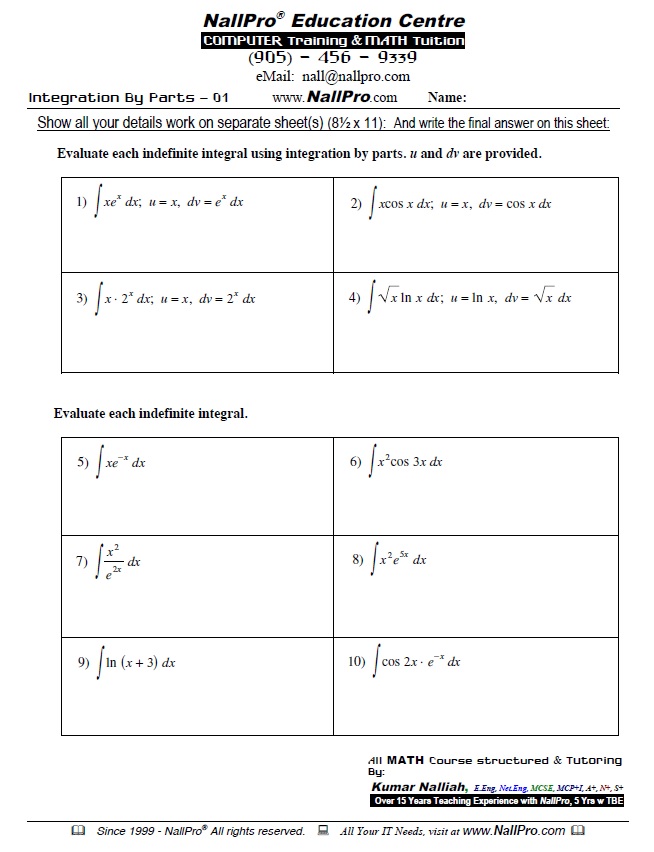
      • Integration by Parts
      • Integration Applications


    Register ON-LINE


    Copyright © Since 1999 - NallPro® All rights reserved.